
Article Read Time

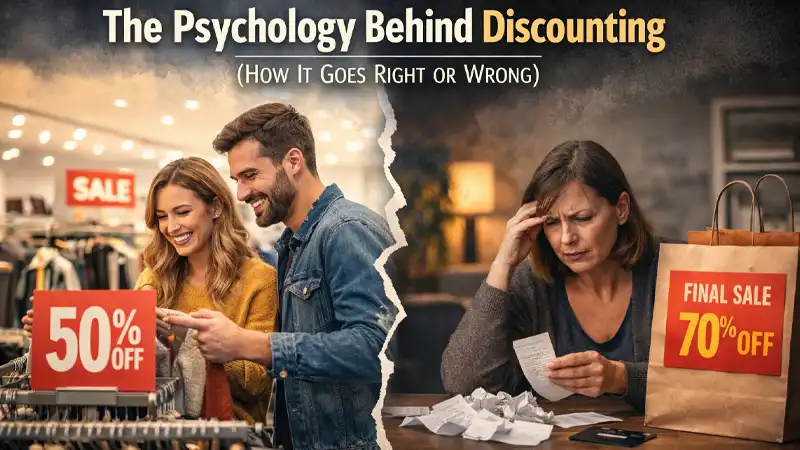
Discounting works because it changes how people perceive value, not just what they pay. A “20% off” tag can feel like a win, a “limited-time” offer can create urgency, and a coupon can provide a small dopamine hit for “beating the system.” But the same psychological levers that make discounting powerful also make it risky: overuse can train customers to wait, weaken brand trust, and turn “value” into “cheap.”
Why discounts feel so good: the mental mechanics
1) Reference prices and anchoring
Most shoppers don’t carry perfect price knowledge. Instead, they rely on a reference price, which they believe something “should” cost. When you show “$100, now $50,” you anchor the buyer to $100 and make $50 feel like a bargain, even if $50 is the product’s normal market price. This is why high-low retail (frequent markups followed by markdowns) can be so seductive.
2) Loss aversion
People feel losses more strongly than gains. A discount reframes purchase hesitation as avoiding a loss: “If I don’t buy now, I’m losing $20.” That’s a different emotional experience than “I’m spending $80.”
3) Urgency, scarcity, and the thrill of the hunt
Limited-time deals create a competition mindset (“act now or miss out”). Coupons and flash sales add a game-like layer that customers feel clever for finding the deal. JCPenney’s failed attempt to remove coupons highlighted this: part of what customers were buying was the excitement of the deal itself, and predictable pricing felt “boring” by comparison.
4) Fairness and trust
Discounting also triggers fairness judgments: “Is this price reasonable?” “Why is it cheaper for them than for me?” In categories with variable pricing (like travel), people tolerate price differences better when rules feel understandable (e.g., buy earlier, accept restrictions) than when prices seem arbitrary.
Real-world examples of good discounting
Example 1: Airlines’ advance-purchase discounts (structured, rule-based)
Airlines frequently charge higher prices closer to departure while offering deeper discounts further in advance. The psychology works because it maps to an intuitive trade: plan early and accept restrictions for a better price; buy late and pay for flexibility and certainty. It’s classic segmentation—price-sensitive leisure travelers self-select into cheaper, earlier purchases, while business travelers often pay more for timing and flexibility.
Why it’s “good” discounting:
- It protects price integrity (not everyone gets the cheap price; conditions apply).
- It aligns with operational reality (capacity perishable; empty seats can’t be stored).
- It feels fairer because the “rules” are legible.
Example 2: Black Friday doorbusters as loss leaders (targeted, strategic)
Many retailers use doorbusters as loss leaders, items sold at little or no profit, to bring customers in, expecting additional purchases once shoppers are in the store or on the site.
Why it’s “good” discounting:
- It’s deliberate and bounded (specific SKUs, specific time window).
- The goal is traffic + basket-building, not permanently lowering perceived value across the whole catalog.
- It creates excitement without redefining the everyday price of everything.
Real-world examples of bad discounting (or bad discount strategy)
Example 1: Groupon-style deep discounts that attract the wrong customer
Groupon deals can flood a business with bargain-seekers who may not return at full price, and the economics can be brutal once platform fees, redemption rates, and marginal costs are taken into account. Reporting and research have found that meaningful shares of merchants lose money and/or say they wouldn’t run such deals again.
Why it’s “bad” discounting:
- It often brings high-volume, low-loyalty customers.
- Service businesses can get crushed by capacity constraints (you can’t “inventory” salon appointments).
- It conditions customers to associate the brand with “half off,” making full price feel unfair.
Example 2: Training customers to wait (the JCPenney “coupon withdrawal” problem)
JCPenney’s “Fair and Square” effort tried to eliminate coupon-chasing and replace it with simpler everyday pricing. But shoppers who had been trained to expect promotions didn’t simply switch their mental model. As one analysis put it, consumers want deals and will wait for them; predictable pricing removed the “Wow, what a deal!” feeling.
The lesson: even “less discounting” can fail if you’ve already built a customer base that shops the discount as much as the merchandise.
The Bottom Line: Practical rules to keep discounting from damaging your brand
- Define the job of the discount. Is it customer acquisition, inventory clearance, trial, reactivation, or competitive defense? If you can’t name the job, you’re probably discounting out of habit.
- Keep it segmented. Make discounts conditional (first purchase, bundles, off-peak times, limited SKUs, loyalty tiers). This preserves your full-price position.
- Prefer value-add when possible. Bundles, bonus services, free shipping thresholds, or limited gifts can feel like deals without requiring you to rewrite your reference price.
- Avoid “perpetual promotion.” If everything is always on sale, nothing is. Customers learn the pattern and delay purchases.
- Measure beyond revenue. Track repeat rate, margin, customer support burden, capacity strain, and post-promo churn. Groupon-type promotions often “win” on volume and lose on economics.
Discounting is not inherently good or bad; it’s a psychological tool. Used with clear purpose and boundaries, it can drive trial and demand. Used as a reflex, it can quietly reprogram customers to believe your product is only worth the discounted price.
Need help? That’s what we are here for. Contact TCHQ Communications today at 502-209-7619.


You must be logged in to post a comment.