
Article Read Time

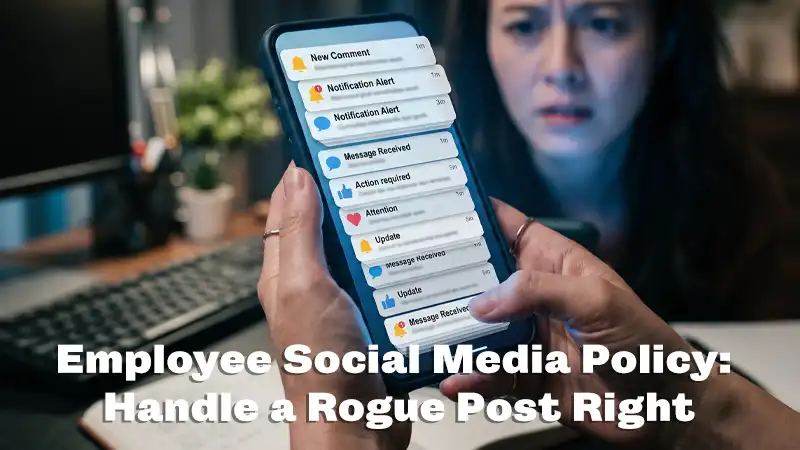
Don’t think you need an employee social media policy? Here’s a scenario that keeps business owners up at night, and it should. It’s a Tuesday. Nothing is wrong. Then your phone lights up because someone on your team posted something online, and now it’s spreading. Maybe it was a rant on their personal account that named your company. Maybe it was a tone-deaf reply from your business page that a frustrated employee fired off at midnight. It’s possible they made a comment they believed was private, but in reality it wasn’t. Either way, the internal just became public, and everyone is looking at you.
Look, this is one of the most common ways a small business ends up in a crisis it never saw coming. Not a product recall. Not a data breach. Just a human being with a phone and a bad moment. And because it feels personal and messy, owners tend to react emotionally rather than with a plan. Let’s fix that.
First, Slow Down and Get the Receipts
The instinct is to act fast. Delete it, fire them, post an apology, do something. Resist that for about ten minutes, because your first move should be to gather information, not take action.
Screenshot everything before it disappears. The original post, the replies, the timestamps, who shared it, and the context around it. People delete things once they realize they’ve gone too far, and if you don’t capture it, you’ll be trying to manage a story you can’t even see anymore. Save it all in one place. You’ll need it for the conversation with the employee, and possibly for HR or legal.
Then ask the question that actually matters: how bad is this, really? There’s a big difference between an employee venting about a long shift and an employee posting something hateful, threatening, or illegal. One is a management conversation. The other might be a firing and a formal statement. Match your response to the actual severity, not to how anxious the notifications are making you feel.
Talk to the Person Before You Talk to the Public
Before posting anything publicly, make sure to have a thoughtful internal conversation first. Bring the screenshots. Allow the employee an opportunity to explain the situation. There are instances where an account may have been hacked, where there could be a misunderstanding, or in some cases, the issue might genuinely be as serious as it appears. It’s important to gather all the facts before you associate your name with any account of events.
This is also where your earlier work on internal communications pays off. If your team already knows how to raise issues, who to call, and that you’d rather hear about a problem from them than from Twitter, you’ll get a heads-up instead of an ambush. A team that trusts you tells you when they’ve messed up. A team that fears you lets you find out from a screenshot.
Should You Make a Public Statement?
Not always. This is the part people get wrong in both directions.
Sometimes the smartest move is to quietly handle it and say nothing, because a public statement just pours fuel on a fire that was about to burn out on its own. If three people saw it, you don’t need a press release. You need to delete the post from any company account, address it internally, and move on.
But when the post is spreading, when customers are asking, or when it involves something genuinely harmful, silence reads as agreement. In that case, keep your statement short, calm, and human. Acknowledge it happened. Make it clear it doesn’t reflect your values. Say what you’re doing about it. Do not overexplain, do not throw the employee to the wolves for sport, and do not make promises you can’t keep. Steady beats clever every single time in a moment like this.
The Real Fix Happens Before Any of This
Here’s the thing nobody wants to hear in the middle of a mess: the best time to handle a rogue post was six months ago, in a policy.
Most small businesses don’t have a social media policy, so employees are left guessing about what’s okay. Write one. Keep it plain. Spell out who speaks for the company online, what’s off-limits, how personal accounts and the business relate, and what happens when the line gets crossed. Then actually talk about it, because a policy buried in a handbook nobody reads is just paperwork. Walk your team through it once a year, just as you’d cover any other part of doing the job well.
That’s not about controlling people. It’s about protecting everyone, your employees included, from a bad two-minute decision that follows the whole company around.
The Bottom Line on Employee Social Media Policy
An employee going rogue online isn’t a sign you hired badly or run a loose ship. It’s a normal risk of employing humans in a connected world. What separates the businesses that recover from those that spiral is simple: capture the facts first, talk to the person before the public, make a statement only when warranted, and put a policy in place so that the next moment of poor judgment has guardrails.
Not sure how you’d handle it if it happened tomorrow, or whether you even need a statement? That’s exactly the kind of thing worth sorting out before you’re staring at the notifications. Give us a call at 502-209-7619. No pitch, no pressure, just a real conversation about getting your team and your response ready.



You must be logged in to post a comment.