
Article Read Time

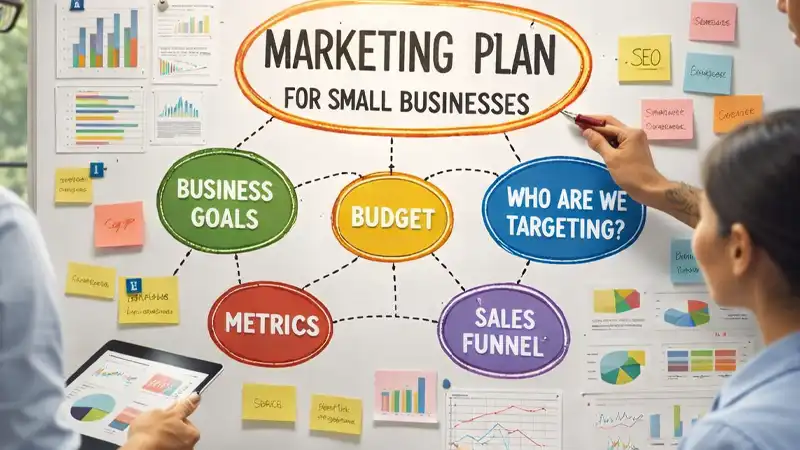
A marketing plan shouldn’t be a binder that sits on a shelf. For a small business, it should function like a practical operating system: clear priorities, a simple set of actions, and a way to measure whether what you’re doing is actually working. The best plans don’t try to do everything. They focus on what will drive growth with the time and budget you really have.
Here’s a straightforward approach to building a marketing plan that works, even if you can’t execute it without a full-time marketing department.
Start With the Business Goal (Not the Marketing Tactics)
Before you choose platforms or design ads, define the business outcome you’re trying to achieve in the next 90 days and the next 12 months. Goals should be specific enough that you can tell if you hit them.
Examples:
- Add 30 new monthly customers
- Increase average order value by 10%
- Generate 50 qualified leads per month
- Book 20 consultations per month
- Improve retention so repeat purchases rise by 15%
Marketing is only valuable if it moves a business metric. A plan without a goal is just activity.
Define Your “Ideal Customer” in Real-World Terms
Small businesses often try to market to “everyone nearby.” That usually leads to generic messaging and weak ROI. Instead, pick the best customer you want more of and define them in practical terms:
- What problem are they trying to solve?
- What triggers them to start looking?
- What objections stop them from buying?
- Where do they search for options?
- What makes them trust a provider?
You don’t need a 12-page persona document. You need clarity. If you can describe your best customer in a few sentences and understand why they buy, you can write better ads, build better offers, and choose better channels.
Build Your Core Message: What You Do, Who It’s For, Why You’re Better
Most small business marketing fails because the message is unclear. Your marketing plan should lock in a simple message that shows up everywhere on your website, social, signage, print, ads, and in sales conversations.
A strong message answers:
- What you do: the service or product, plainly stated
- Who you help: the audience or the use case
- Why you’re the right choice: proof and differentiation
Examples of “proof”:
- Years in business
- Local awards or certifications
- Number of customers served
- Reviews and testimonials
- Guarantees or warranties
- Before/after results (where appropriate)
This is your marketing foundation. If your message is fuzzy, no channel will fix it.
Choose the Right Channels With a “Customer Path” Mindset
A small business plan should match how customers actually behave. Most buyers don’t go from “never heard of you” to “purchase” in one step. They move through a path:
- Awareness: they learn you exist
- Consideration: they compare options
- Conversion: they call, book, buy, or visit
- Retention: they return and refer others
Your plan should include at least one tactic for each stage, even if it’s simple. For example:
- Awareness: local SEO, community sponsorships, signage, short-form video
- Consideration: reviews strategy, case studies, comparison pages, FAQs
- Conversion: strong offers, booking links, call tracking, fast response times
- Retention: email/SMS follow-ups, loyalty perks, seasonal check-ins
If you only run awareness ads without improving conversion, you’ll feel like marketing “doesn’t work.” If you only post on social without a straightforward way to book or buy, you’ll get likes but not revenue.
Set a Marketing Plan Budget Based on Reality, Then Allocate It Intentionally
You don’t need a massive budget, but you do need consistency. Many small businesses spend randomly $50 here, $200 there, then wonder why nothing sticks.
Start by choosing a monthly marketing budget you can sustain for at least 90 days. Then split it into three buckets:
- Always-on foundations (non-negotiable)
- Website upkeep, basic creative, and reputation management
- Local SEO and Google Business Profile optimization
- Demand capture (high intent)
- Google Search ads for key services
- Retargeting to people who visited your site
- Demand creation (visibility)
- Social content, local events, out-of-home, partnerships, video
If you’re budget-limited, prioritize foundations and demand capture first. Those usually produce the most measurable short-term ROI.
Create a Simple 90-Day Execution Marketing Plan.
A plan that works should translate into weekly actions. The 90-day window is ideal because it’s long enough to see results and short enough to stay focused.
Your 90-day plan should include:
- A small set of core campaigns (1–3 max)
- A content rhythm you can sustain (not one you wish you could sustain)
- Clear ownership: who does what, and when
- A simple tracking setup
Example structure:
- Weekly: 2 social posts, respond to reviews, track leads, and calls
- Biweekly: one email to customers/prospects, update one website page
- Monthly: one promotion or seasonal push, one partnership/community activation
Consistency beats intensity. A manageable plan you run for 12 months will outperform an ambitious plan you abandon in 3 weeks.
Measure What Matters: Leads, Sales, and Cost Per Result
Small businesses often track the wrong metrics: likes, impressions, and follower count. Those can be helpful indicators, but they’re not the score.
Your plan should track a few meaningful numbers:
- Leads generated (calls, forms, bookings, walk-ins)
- Conversion rate (how many leads become customers)
- Cost per lead (if running ads)
- Revenue per customer (average order value or lifetime value)
- Retention/referrals (repeat business and word-of-mouth)
If you don’t track anything, you can’t improve. If you track too much, you’ll stop tracking. Keep it simple.
Make Your Marketing Plan Resilient: Build in Review and Adjustment
The most effective marketing plans are living documents. Set a quick monthly review (30–45 minutes) to answer:
- What worked this month?
- What didn’t work?
- What did we learn about customer behavior?
- What are we changing next month?
Marketing is not about being perfect. It’s about running smart cycles: test, learn, improve.
Bottom Line on a Marketing Plan
A marketing plan that works for small businesses is not complicated. It’s focused. It starts with a clear business goal, targets a specific customer, sharpens a consistent message, and uses a handful of channels that match how people actually buy. It prioritizes execution over theory and measures results in leads, sales, and repeat customers.
If you want a plan you can actually follow, build it around what your team can sustain, then run it consistently for 90 days. That’s where real marketing momentum starts.
Need help? That’s what we are here for. Contact TCHQ Communications today at 502-209-7619.

You must be logged in to post a comment.