
Article Read Time

Digital ads get all the attention over billboard and transit advertising because they’re clickable, trackable, and instantly adjustable. But when it comes to reach, repetition, and local dominance, billboards and transit advertising can deliver a return that’s hard to replicate online, especially for businesses that serve a defined geographic area.
The key is understanding what return on investment (ROI) really means in out-of-home (OOH) advertising and how to measure it without expecting it to behave like a Facebook ad.
What ROI Looks Like in Billboard and Transit Advertising
Return on investment is simple in theory:
ROI = (Profit from the campaign – Campaign cost) ÷ Campaign cost
The challenge is determining “profit from the campaign” when OOH doesn’t come with built-in clicks. In practice, ROI for billboards and transit is typically measured through a blend of:
- Direct response (calls, form fills, coupon redemptions, QR scans)
- Lift in branded demand (more searches for your business name, more direct website traffic)
- Foot traffic lift (store visits, appointments booked, event attendance)
- Sales lift in the advertised area (comparing pre/post or test vs. control markets)
- Long-term brand effects (higher conversion rates from other channels, stronger recall)
The best OOH campaigns don’t just “get seen.” They make your other marketing work harder.
Why Billboard Advertising Can Produce Strong ROI
Billboards are a high-frequency medium. You’re not buying a single impression—you’re buying a pattern of repeated exposure among the same local population.
That repetition drives ROI in three common ways:
- Top-of-mind recall
When someone needs what you sell, your name is the first they remember. That reduces decision friction and increases conversion rates across every channel—web, phone, walk-in, referrals. - Geographic precision
If you pick placements strategically (near retail corridors, commuter routes, and high-traffic intersections), you’re reaching people who can realistically become customers. - Competitive presence
In many markets, a billboard is a statement: we’re established, we’re nearby, and we’re not going anywhere. That perception matters, especially for professional services, healthcare, home services, auto, and local retail.
Transit Advertising: ROI Through Repetition and Trust
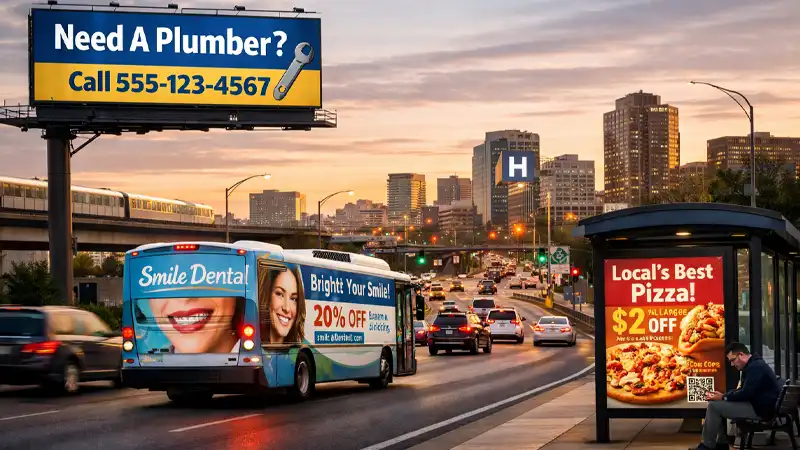
Transit advertising includes buses, shelters, benches, wraps, station posters, and even interior placements. It can be particularly effective when your customers overlap with commuter routes, downtown corridors, campuses, hospitals, or entertainment districts.
Where transit shines:
- Dense frequency in a concentrated area
- Extended dwell time (people waiting at stops or sitting in traffic)
- “Neighborhood credibility” (your brand becomes part of the local landscape)
Transit can also be cost-efficient. A shelter or bus-side placement may reach fewer total people than a highway billboard, but it often delivers stronger local relevance and more repeated exposure to the same audience.
The Real ROI Advantage: Billboard and Transit Advertising Amplifies Everything Else
One of the most overlooked benefits of OOH is that it boosts performance in your other channels. When a billboard or bus ad is running, you often see:
- Higher click-through rates on paid search and social (people recognize the name)
- More branded searches (“Company Name + service”)
- More direct traffic to your website
- Better conversion rates because trust is already established
This is why OOH can look “expensive” if you only judge it by direct response—but profitable when you measure total impact.
How to Track ROI (Without Guessing)
You don’t need perfect attribution to measure ROI. You need clean signals.
Here are practical methods that work for small and mid-sized organizations:
- Dedicated landing pages
Example:yourbusiness.com/routeoryourbusiness.com/offer(easy to track and remember) - Unique phone numbers
Use call tracking numbers tied specifically to billboard/transit placements. - Promo codes
Works well for retail, restaurants, membership offers, and events. - Branded search and direct traffic monitoring
Watch Google Search Console, Google Trends (for your area), and analytics for increases throughout the campaign. - Geo-lift testing
Run OOH in one area and not the other, then compare lead/sales patterns. - Ask “How did you hear about us?” the right way.
Add “billboard” and “bus ad” as specific options in forms and call scripts.
The goal isn’t to attribute every sale. The goal is to show a measurable lift that justifies the spend.
What Makes Billboard and Transit Advertising ROI Go Up (or Collapse)
OOH can be incredibly efficient or a waste depending on execution.
ROI increases when:
- Your message is simple and readable in 3–5 seconds
- You have one clear call to action (and it’s easy)
- The placement matches your customer’s real-world routes
- You run long enough to build frequency (often 8–12+ weeks)
- Your online presence is ready (fast website, clear offer, strong reviews)
ROI collapses when:
- The design is cluttered (too many words, too many services)
- The call to action is complicated (long URLs, vague “learn more”)
- The billboard is in the wrong direction or has the wrong traffic pattern
- You expect instant results from a short run
- Your landing experience is weak (slow site, confusing messaging, no trust signals)
Setting Realistic Expectations
Billboards and transit aren’t usually “launch today, profit tomorrow” channels. They’re best viewed as momentum builders, tools that create consistent visibility and strengthen your entire funnel.
That said, many local businesses see ROI within a single campaign cycle when they pair OOH with:
- Paid search (to capture the demand you create)
- Social retargeting (to stay in front of curious prospects)
- A clear offer or appointment path
- Strong reputation management (reviews matter more when awareness rises)
Bottom Line
Billboard and transit advertising deliver ROI when you treat them like what they are: high-frequency, location-based visibility engines. They’re not just about impressions; they’re about mental availability—making sure your brand is the one people think of when the need arises.
If you plan the placement strategically, keep the message brutally simple, and track the right signals, out-of-home can become one of the most reliable—and underrated—local marketing investments you can make.
Need help? That’s what we are here for. Contact TCHQ Communications today at 502-209-7619.

You must be logged in to post a comment.